Showing posts with label Communication Skills. Show all posts

Wednesday, July 24, 2024

Does He Know How to Listen?

Does He Know How to Listen?

By Steve Beckow

Posted on July 24, 2024


Does he know how to listen? Credit: Coursera

I was talking to a young friend the other day who may be entering a new relationship.

I imagined her asking me what she should look for in a relationship.

I had no problem answering that question. From my personal perspective?

Does he know how to listen?

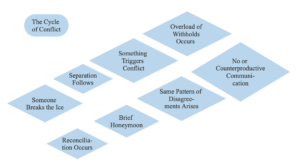
If he knows how to listen, and you do as well, you have a chance to escape the cycle of conflict, which most relationships fall into at some point. (1)

How does listening work? Let me focus on what decades ago I used to call “restorative” listening because that’s the crucial type of listening, in my view, in a relationship.

We’re wanting to escape the cycle of conflict and it calls for a more intensive form of listening than ordinarily.

First thing is you don’t listen for what you want to hear. You listen for what he wants to tell you. He speaks because he wants you to hear and understand something. What is it?

Listening is not about you. It’s not about you reviewing what you just said to see how you did, when he’s speaking.

It’s not about you planning what you’ll say next. It’s not a pit stop where you change your tires while you get your next thought.

And it certainly isn’t about you interrupting his train of thought or walking away with the microphone. It takes work and concentration on our part to be the listener.

If anything it’s blue-sky stillness of mind into which is gathered all he says and spread out on the table – for him to see.

Second, moderate feedback is good.  It shows you’re listening. “You seem to feel sad. I hear the urgency of it. It sounds disturbing.” And then let it go.

Exception: It may further the process for you, at some point, to offer just a short insight about yourself (“I do that too”) to show you have an ante in the game. Be brief and then yield the microphone.

Third, listening is about you getting the real message that the speaker wants you to get. Sometimes that message – well, often, I think – is conveyed in or modified by gestures, inflection, mannerisms, etc.

The words may be different accompanied by different inflections. You need to “hear” everything to understand what the speaker is wanting you to get.

Fourth, treat everything he says as a chapter heading and unfold it. Don’t be surprised if he repeats the telling. The first time is for the story. The second time is for how he feels, now having seen the full story.

***

What’s the overall objective of listening of the kind I’m describing? It’s to give him the opportunity to put everything on the table and see what he’s doing and what barriers he’s meeting.

At some point he should have an “Aha!” and whatever troubled him will vanish. The truth will have set him free. (2)

This kind of listening should keep us out of the cycle of conflict if used lovingly, without judgment, and without undue interruption or redirection. It defuses. It satisfies. But it’s rare in our society.

It works provided the issues that are being discussed are solvable and the two people want a solution.

I always assume that the speaker knows what he needs. He just hasn’t been able to find anyone who will help by purely listening.

***

After G/NESARA (3) the remnants of a paradigm of a woman needing to rely on a man for her financial wellbeing will disappear. Poof! Women will have a guaranteed means of survival.

Then relationships may reflect the person’s pure interests and last as long as the two remain interested. There won’t be a need for marriage. They do not marry in heaven, remember? (4)

There’s no need for it. (5)

Footnotes

(1) See:

Cycle of Conflict:

We go around and around this cycle, our feelings for the other eroding a little more as we go, until we drop or leave. In a word? “Listening” is what’s missing. Oh, and love.

(2) And you can use the truth to guide you. If he is getting freer and freer of tension, the truth is being spoken. Barring venting, which is a good thing, if he’s getting more and more ornery, chances are there’s something not being said here.

Use the truth and his release as your guide in knowing what to listen to and what to gently inquire into (if it’s appropriate; don’t shanghai his share).

(2)  The Global/National Economic Security and Reformation Act, mandating a new economic order based on fairness, compassion, and universality.

See What’s Next?
 Vol. 5: G/NESARA at https://goldenageofgaia.com/wp-content/uploads/2024/01/Whats-Next-5-2.pdf

(3) For when they shall rise from the dead [i.e., ascend]
they neither marry
nor are given in marriage;
but are as the angels
which are in heaven.
(Mark 12:25.)

(4) There are no reasons for marriage in the higher dimensions. There are no threats for which we need to bind together and bond. One doesn’t face a poverty-stricken old age.

I used to know about child-rearing on the higher planes, but I’ve forgotten and haven’t written on it.

People come together and part as they please, for as long as it rewards them. What makes all this possible is the love which we’ll also experience one day soon. If we felt  that love for a moment, all would make sense.

Everything about family, sexuality, etc., is different in the higher dimensions.

There’s a book waiting to be written. The closest I’ve come to it is New Maps of Heaven at https://goldengaiadb.com/index.php?title=New_Maps_of_Heaven


Steve Beckow

Friday, March 29, 2024

There is No Greater Gift than Listening 2. How to Listening

There is No Greater Gift than Listening 

Vol. 2. How to Listening

By Steve Beckow

Posted on March 29, 2024


I’m listening

I’m so excited about this book that I’m jumping about in my seat as I post this.

I’m writing a series of books on listening in the hope that this now-seemingly-neglected skill becomes a cherished practice again in our now-global society.

All my life, I’ve valued listening. My soul-contract design team must have wanted this because I chose to be born the runt of the litter, to whom listening from the male side did not come easily.

Listening from the female side came very easily. I was amply gifted by my Mother. Everything I learned about listening I learned from trying to understand what it was she did that made her so beloved by her circle of friends.

From my experience as a grad student in Sociology, listening to other people as part of my small-groups studies, I know what a gift listening is.

I’ve seen people get the source of an ancient or a nuclear issue in their relationship and weep.  I listened to one person for eight hours. It was miraculous.

On the other hand, I’ve also seen people not let each other finish a sentence. And later they complain of having an empty life. Not surprisingly.

Listening is what’s seemingly lacking in our society. We promote bodily pleasures, but not the deep inner pleasure that comes from being heard.

An interesting side note was that, when I had a watershed spiritual experience, I had it because of something that arises from listening.

I’m referring to my vision of the purpose of life, which occurred on March 13, 1987. (1)

As I drove my car to work, I said to the universe, if people’s lives are a puzzle and, when it’s solved, the puzzle becomes a picture, could it be that life itself is a puzzle and, if so, what is the picture that life is?

Boom! The car went black and I was staring at an inner tableau or movie of the total journey of an individual soul from God to God.


The journey from God to God that all of us make

I emerged from that experience knowing that the purpose of life is enlightenment. (2)

For me, being given this experience was the highpoint of my then-active career as a promoter of listening. My work life took me in different directions and here we are.

But I’ve never lost the special place in my heart that those years of restorative listening brought, as well as the years with enlightenment intensives, which also revolved around listening.

A note on logistics. This book is a combination of posted articles and extracts from a manual on listening.

There may be some repetition that I haven’t caught. After the Reval, I’ll hire an editor to remove it. Right now, my priority is getting the message out. Very soon, with the advent of the emergency broadcasts, there may be a great number of us who need listening. And many of us who wonder how to do it.

I hope this book will supply that need.

I look forward to the years when our feeling of a lack of love is endlessly and forever filled to the brim with love. I predict a time and space will arrive for immensely-rewarding conversations, with speaking and listening equally balanced and equally supportive.


Download There is No Greater Gift than Listening – Vol. 2. How to Listen here:  https://goldenageofgaia.com/wp-content/uploads/2024/03/There-is-No-Greater-Gift-Than-Listening-V2-How-to-Listen-R5.pdf


Footnotes

(1) For the rest of the experience, see “Ch. 13. Epilogue” in The Purpose of Life is Enlightenment at https://goldenageofgaia.com/wp-content/uploads/2021/07/Purpose-of-Life-is-Enlightenment-3.pdf

(2) The purpose of life is that God should meet God in a moment of our enlightenment. And for that purpose was all of life, all the universes, all matter (mater, Mother) created.

Steve Beckow


Friday, September 15, 2023

The Cycle of Conflict is a Relationship Killer

The Cycle of Conflict is a Relationship Killer 

By Steve Beckow

Posted on September 15, 2023

Part 1/2


Every relationship I’ve ever lost, I’ve lost to an inability or unwillingness on my part or someone else’s (or both) to handle conflict.


Download Leaving the Cycle of Conflict here: https://goldenageofgaia.com/wp-content/uploads/2023/09/Leaving-the-Cycle-of-Conflict-17.pdf


I’m tempted to say that we don’t have “relationships.” We have connections that are wonderful to begin with and then are choked off by the cycle of conflict and die.

You hear that Jim and Jane are having troubles. Oh, they’re back together again. No, they’re having troubles again. No, they’re back. No, they’ve separated for good now.

Does that not sound familiar? I can name several couples exactly like that that I know – in fact, every couple who’ve ever separated. One of those repeat participants would be me.

No, we weren’t taught the way out in schools. I went to countless therapists, psychiatrists, etc., etc., and didn’t learn a thing.

The teachers that worked were in the growth movement. They were the ones ploughing new ground.

Ben Wong, Jock McKeen, Werner Erhard, Claude Bernier, the circuit riders, I could go on and on. I acknowledge your contribution to me. I say what I say next as the result of what you (and my guides) taught me.

Let me re-introduce my graphic here.

Conflict arises when we don’t get what we want or need and there’s no good and apparent reason why not.

Conflict arises when “delicate” subjects are avoided and yet must be addressed.

Conflict arises when one person does not care for another, not really, when people of good intent feel taken advantage of, when a person feels unlistened to, disrespected, unvalued.

When any or all of these conditions are present, we find our love for a person pitted against our desire or need for our request for support or change to be at least addressed, if not granted.

I’m only talking about those requests for support that are not listened to or not granted and we feel they should or need to be. These are at the heart of the conflict.

When the desire and the “access denied” both persist, frustration builds. The pressure of our withheld communications begins to distract us. If our intention to deliver the communication is thwarted again and again, more pressure is added.

Until something occurs that ignites an explosion. A triggering comment. A gesture or word of disrespect, a lack of appreciation, anything sets it off.

I’m serious about talking about this subject. I’d like everyone in our lightworker family here to get this cycle down to our toes. This is a relationship killer and it needn’t be happening.

We must have it be gone from our arsenal … errrr … repertoire of communicational strategies.

***

To review, first….

(Concluded in Part 2, below.)

Part 2/2

(Concluded from Part 1, above.)

To review, first, what happens in this cycle is that discussion of a matter is left until one party is ready to blow. That in itself is not a great strategy.


Download Leaving the Cycle of Conflict here: https://goldenageofgaia.com/wp-content/uploads/2023/09/Leaving-the-Cycle-of-Conflict-17.pdf


Communication needs to happen sooner and on a regular basis until it becomes second nature. Until it flows, as it did with us after three months of encounter at Cold Mountain Institute.

Second, we have to be committed to this process – or get out of the relationship and save those who are committed a lot of trouble.

I know what love is (1) and I know that love cannot flourish in a relationship that doesn’t handle conflict.

If you’re a drama queen, this may be the wrong nest for you.  I’m only speaking to the committed. I know, I know. Tough words. But we are in the middle of a war; we need to communicate; and we can’t afford to watch frustration build in our lightworker relationships, not with a war on and a Reval coming.

Third, the speaker needs to communicate the information that’s vital. That is:

(A) How we’re feeling

(B) What we want to see happen

(C) What our situation is

(D) What role we’re willing to play

(E) What we need from the other person.

The other person needs to listen – really listen. (2) Not do two things at once. Not deny the person a face to speak to. Not be doing our shopping list in our head.

The listener now knows how the other person feels, which they can use to gauge the urgency of the situation. They know what the other person wants and what their situation is. They know what the speaker is doing and willing to do in the future about the situation and what help they need.

***

I’m only going to deal with “opening up” communication here. I’m not inspired, because that’s what’s happening, to discuss how the listener might want or need to respond to, address, or avoid conflict.

That inspiration hasn’t come through yet. You’ll be the first to know: “This just in!”

Unless a person is committed to drama, then going about communicating in a sincere and open way, without blaming or shaming, when a want or need comes up and being met and received by the other with a corresponding degree of sincerity should be enough to take the process of frustration build-up out of the relationship.

There is then the other side of the exchange: What we do with the communication. I’ll know more about that when the information comes in.

Seriously I have my overload limit. Where’s my coffee? One thing at a time here!


Download Leaving the Cycle of Conflict here: https://goldenageofgaia.com/wp-content/uploads/2023/09/Leaving-the-Cycle-of-Conflict-17.pdf


Thursday, September 7, 2023

Productive and Unproductive Communication

Productive and Unproductive Communication

By Steve Beckow

Posted on September 6, 2023


No or Unproductive Communication

When we won’t communicate at all or communicate with blame and shame or other unproductive strategies, the other person tends to clam up. Then the issues and withholds (undelivered communications) start to build up.

If nothing changes or gets better ever, the person may just one day up and leave.

Someone told me the other day of a man who left for soccer practice one day and then suddenly needed to return to get his cellphone. There he saw his wife’s brother moving all her stuff out. This was the first the husband knew about it.

It’s my belief that people who go round and round this unfortunate loop, comforting themselves that them getting back together is the main thing, one day just eventually quit, like the player’s wife. Or find that their partner has just quit, like the player.

Going round and round is wearing and dull. One day we stop caring. Past that, we just want out.

Good/Bad, Right/Wrong

I’d like to focus on one type of unproductive discussion we have which I call good/bad, right/wrong.

One reason why I don’t advise discussing matters from the intellectual level is because they so often devolve into good/bad, right/wrong. And that can become like quicksand, into which we sink … and disappear.

We argue incessantly about factors that aren’t even what motivate us into action.

In right/wrong, you say A and I say B. And we both defend our positions.

But if we switched places, dollars to donuts I’d be saying A and you’d be saying B. All seems to depend on our point of view, our vantage point, where we sit, and not on the truth of the matter.

Again, in our zero sum thinking, if we’re right, someone else has to be wrong. That leaves a lot of bruises and other residue, often festering and contributing in turn to another turn of the carousel.

Discussion seldom gets above good/bad, right/wrong and thus proves fruitless and stultifying. It leads nowhere and simply exhausts everyone. We need to up-level it to the experiential level and focus on how we feel.

Communicating How We Feel

Communicating how we feel is the information the other needs to know regarding whether to act or not. (1) “I’m concerned.” No action. “I’m helpless. Please! Somebody!” Concerted action! Our feelings are the factor that motivate us to action.

Communicating how we feel has other advantages. First, it’s verifiable by me. Only I feel what I feel. And only I know how I feel. It isn’t something that can be messed with. I’m the expert on the subject.

But many people, if I asked them how they’re feeling, might not know what to answer. How would I know what I’m feeling? Where would I look? I don’t know how I feel.

Our ability to maneuver in this territory may be limited at the moment, but I’m certain our emotional IQ will rise dramatically in the weeks and months ahead.

Feedback

Sincerely trying on feedback is also needed. Without our partner being able to deliver feedback, again, the situation might never change.

The ordinary tendency is to rebuff feedback, deny it, contest it, and in other ways resist it. That ultimately leads to lethargy in us and resistance in our partner.

What is lethargy? I’m asleep and I’m asleep to the fact that I’m asleep. In Hinduism, this condition is called the guna or cosmic force of thamas.

If you really observe thamas or lethargy, you’ll see it’s like a blanket that smothers everything but the most basic of actions and interactions.

How do we “receive” feedback? Try it on. Test it out. See if it fits. If it does, own it.

Tomorrow we look at true reconciliation.

Footnotes

(1) On the value of listening, see:

Steve Beckow